

Green is easier to see; red is cheaper. Both are equally accurate. If you work in bright rooms, new-build plots with big windows, or over longer distances, a green laser saves you squinting. If you mostly work in dim rooms and want the longest battery life for the money, red does the job.
01Green vs red at a glance
| Feature | Green laser | Red laser |
|---|---|---|
| Visibility | Much easier to see, especially in bright rooms | Fine in dim rooms, harder in daylight |
| Accuracy | Same | Same |
| Battery life | Shorter per charge | Longer per charge |
| Price | Higher | Lower |
| Best for | Fit-outs, kitchens, tiling, bright or large rooms | Occasional DIY, darker rooms, tight budgets |
02Why green looks brighter
The human eye is most sensitive to green light. So a green beam of similar power looks noticeably brighter than a red one, and DeWalt quotes its green lines as up to four times brighter than red. In practice that means you can see the line further across a room and in daylight, without needing to dim the lights or use a detector.
The trade-off is power and price. Green laser diodes cost more and draw more from the battery, so you'll get fewer hours per charge than from an equivalent red laser.
03Which one should you buy?
Choose green if…
- You work in bright rooms: new builds, extensions, conservatories, rooms with big windows.
- You set out across large spaces, such as open-plan kitchens or commercial fit-outs.
- You use a laser most days, so saved time adds up.
Choose red if…
- You use a laser occasionally for shelves, pictures or a single room.
- You mostly work in dim spaces or in the evenings.
- You want the longest battery life for the lowest price.
Accuracy is the same either way. Both DeWalt green lasers we stock are rated to ±3mm at 10m.
04Cross-line or 3 × 360°?
Colour is one choice. The other is how many lines you need.
| Type | What it projects | Good for |
|---|---|---|
| Cross-line | One horizontal and one vertical line in front of the laser | Hanging cabinets, shelving, tiling one wall, door and window frames |
| 3 × 360° | A level line all the way round the room plus two vertical planes at 90° | Whole-room setting out: ceilings, stud walls, dado rails, kitchens |
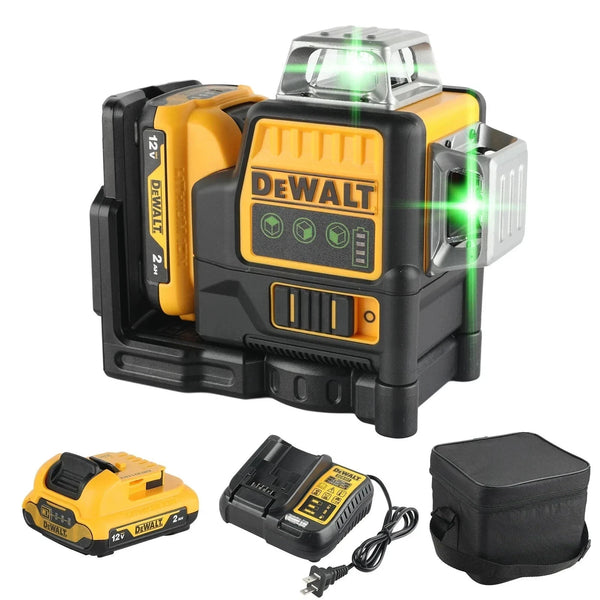

The DW089LG gives you three full 360° planes, with up to 30m visible range (around 50m with a detector). The DCE088D1G is a cross-line kit with a 4° self-levelling range, a magnetic pivoting base, wall bracket, glasses, target card and TSTAK case. Both are IP65 rated against dust and water and come with a battery and charger.
05Tips for better results
- Let it settle. Give a self-levelling laser a second or two after setting it down before you mark.
- Lock the pendulum before moving or packing the laser to protect the internals.
- Use a detector outdoors. In bright sun even green lines fade over distance; pulse mode and a detector extend the range.
- Check calibration now and then by marking a line, turning the laser 180° and checking it lands on the same mark.
- Protect your eyes. Never look into the beam. Laser glasses make the line easier to see but are not safety glasses.
06Frequently asked questions
Is a green laser more accurate than a red one?
No. Colour affects visibility, not accuracy. Accuracy depends on the laser's build and calibration.
Can I use a green laser outdoors?
Yes, and it's easier to see than red in daylight. For long distances in bright sun, use the laser's pulse mode with a compatible detector.
Why does a green laser cost more?
Green laser diodes are more complex and expensive to make, and they use more power.
Do I need a 3 × 360° laser for DIY?
Not usually. A cross-line laser covers most single-wall jobs. A 3 × 360° laser earns its keep when you're setting out whole rooms.
Need help choosing a laser?
Tell us the size of the job and where you'll be working, and we'll point you to the right model.
Leave a comment